Check out this new post on the Velocity Scheduling System blog:
http://www.velocityschedulingsystem.com/overcome-resistance-to-change-here%e2%80%99s-how-using-theory-of-constraints/
The Velocity Scheduling System Coaching Program is a complete scheduling system for highly custom job shops. It is a visual system -- NOT software. Check it out here: http://www.velocityschedulingsystem.com/
Showing posts with label learn theory of constraints. Show all posts
Showing posts with label learn theory of constraints. Show all posts
Sunday, July 24, 2011
Resistance to Change (Here’s HOW to Overcome it using Theory of Constraints)


Saturday, July 9, 2011
Theory of Constraints and TOC Thinking Processes applied to YOUR Life
I have a huge opportunity for you to learn more about the Theory of Constraints and the TOC Thinking Processes.
The Odyssey Program is coming up this July 18 to 25 in San Jose, CA. It's short notice, but it's a great deal. You can attend both the regular session (first 5 days) and the alumni session (last 3 days) which are normally $3500 together for only $1600 for both. And that's all inclusive (ALL meals, accomodations, materials are included).
Why? We are short on attendees due to dealing with Dr Goldratt's passing and we have not had time to market. We need to cover our costs. This price will NOT be available again!
This offer is limited to the first 10 people who respond and mention the Science of Business. I don't make a commission on this, I just really believe in this program and I promised Eli I would help to market TOC the last time I talked to him. The program is 100% run by volunteers and 100% non-profit. It's a must do for EVERYONE!
If you are interested in learning more about the TOC Thinking Processes and in critical thinking -- this is a great opportunity. This is a life opportunity. Read on for the details:
-----------------------------------------------------------------------------------------
The Odyssey Program is a 5-day program that allows participants to apply the powerful insights and thinking processes of Theory of Constraints’s (TOC) to their own life journey. The program is open to everyone wanting to invest time to discover what really blocks them to set and achieve ambitious goals or make important decisions and how to practically challenge assumptions or overcome obstacles that hold us back from achieving more “goal units” or leading more fulfilling lives.This program is aimed at helping attendees develop and apply critical thinking skills to discover the cause-effect patterns, generic conflicts and assumptions that limit success in the various aspects of their life (e.g. wealth, health and happiness) and discover how to practically break these conflicts in ways that do not have any major negatives and or major implementation obstacles.
Attendees can apply these TOC Thinking processes to any personal subject or circumstance (e.g. what to do with the rest of my life, how to live a full life, how to make an important decision).
- Odyssey 2011 Information Brochure - All the latest information about the 2011 program.
- Get to know the Odyssey Facilitator - Dr. Alan Barnard (Freshman and Alumni program facilitator).
- Read all about this years venue – San Jose State University.
Starting points for this analysis can include:
1. How to set a life goal and discover which current assumptions can block you from achieving this life goal and how to overcome these obstacles in a systematic and logical way OR
2. How to make Important decision(s) you've been procrastinating on (such as "what to do with the rest of my life", "Why can't I sustainably quit a bad habit" ) and discovering what underlying conflict(s) blocks them from making these decisions and how to identify and challenge limiting assumptions in a holistic and logical way OR
3. Identifying stressful expectation gaps (gaps between what you really want /where you want to be vs. what you have now/where you are) from three different aspects of your life (e.g health, wealth and happiness) and discovering the common underlying conflict and limiting assumptions that block you from closing these gaps and how to overcome implementation obstacles in a holistic and logical way.
The 3 day Odyssey Alumni program (which follows immediately after the 5 day Freshman) is open to anyone that have previously attended a Odyssey Freshman program (including Odyssey Freshman class of 2011). In this program, Dr Alan Barnard will lead the group, following an exciting discovery process (developed by Dr Goldratt specficcally for the Alumni), to experience a real scientific breakthrough using the thinking processes and principles of the hard sciences's "scientific method" to make a real breakthrough in a topic that is important to both our professional and personal lives. Past Alumni topics included "How to find the essence of something we study/read", "How to really focus on what is important/not get distracted by unimportant stuff", "How to prepare properly when we want to sell a new idea/change".
I have personal experience of the impact of the tools taught at the Odyssey Freshman and Alumni programs and can testify the value it has brought to my life and to our organization.
If you are interested in getting more information or to register for the program can visit http://www.theodysseyprogram.org/. Please note that those interested should register asap by clicking on the "Register" tab, as the program is limited to only 60 participants each year and only the first 10 referrals from the Science of Business will get the discount described above.
To get the discount: simply select the "Young Adult Sharing" option for the Freshman ($1000) and Young Adult Sharing" option for Alumni ($600) on the "Register" tab. Now that price is for SHARING A ROOM ($1600). If you don't want to share select the options immediatly to the right of the yellow hightlights which is a total of $300 more. Then forward your registration to me so that I can okay the special rate. See yellow highlights below:

If you have any questions regarding the program, you may contact us at: info@theodysseyprogram.org. And don't forget to forward your receipt/registration to me so that your discount rate will be accepted.
Remember the Odyssey Program is 100% volunteer and 100% non-profit. We welcome sponsors to support participants from all over the world. Contributions of all levels will be applied to enable someone to achieve their ambitious life goal. We would greatly appreciate donations of frequent flyer miles. Go to the Donate page to donate now, or send an email to info@theodysseyprogram.org if you would like to understand more about sponsoring someone to the Odyssey Program.
Wishing you success,
Dr Lisa
President, Science of Business
Friday, July 2, 2010
The biggest constraint we Theory of Constraints consultants find is ... (part 2)
This is Part 2 of a multi-part series that will be posted on the Velocity Scheduling System Coaching Program blog. We covered the biggest constraints and most common constraints we find as Theory of Constraints consultants.
Read Part 2 here: http://velocityschedulingsystem.wordpress.com/2010/04/14/the-biggest-constraint-we-theory-of-constraints-consultants-find-is-part-2/
Thursday, April 1, 2010
The biggest constraint we Theory of Constraints consultants find is ...
This is Part 1 of a multi-part series that will be posted on the Velocity Scheduling System Coaching Program blog. We covered the biggest constraints we find as Theory of Constraints consultants.
Read Part 1 here: http://velocityschedulingsystem.wordpress.com/2010/03/30/the-biggest-constraint-we-theory-of-constraints-consultants-find-is-%e2%80%a6-part-1/
Wednesday, March 24, 2010
Theory of Constraints POOGI Part 68 -- Employees Need Time Off? That’s unproductive! (conclusion)
We are continuing our series based on The Goal by Eliyahu M Goldratt and the Theory of Constraints. {This series was co-written with Brad Stillahn}
Dr. Lisa: So business owners cope with the issue in several ways. Many let the problem happen to them. They have long-standing vacation policies that dictate how much time off people get, most often dictated by length of service. Many times, the employees get to choose when they would like off, with no limit as to how many people can be off at a time. But, some business owners do manage this, placing a limit on how many people can be off at the same time, and from the same department.
Brad: In my experience, once employees make enough money, time off becomes a high priority. And, that is in conflict with the needs of the business and business owner. I want a secure, satisfied work force to keep turnover down, but the more secure and satisfied they are, the more time off they desire.
Dr. Lisa: Interesting dilemma to have with your best and longest term employees. And, I would guess that you also have employees who constantly need last minute time off to deal with the crisis of the moment.
Brad: Yes, of course.
Dr Lisa: Unplanned time off can be very disruptive. Sometimes, it is the same people who need or take unplanned time off over and over again. That requires enough people in total to cover for the lost productivity. It may be additional "protective capacity" in the department, or in other departments that pitch in to help. Sometimes, the work just sits and waits for the employee to return, especially when no one else has that skill set. That interrupts flow, and flow is the most important thing a business needs to maintain.
Brad: Again, these problems hit small businesses especially hard. There is no one else with the needed skill set and/or there aren't enough people to get the job done in the first place.
Dr. Lisa: How did you handle it as an owner of a label printing business?
Brad: By installing a system that wasn't popular, but was very effective. For all non-exempt employees, I raised pay rates and the vacation that was possible to earn. That was the good news, and provided me the opportunity to put in a system that had some teeth to it. Everyone earned vacation by working a full work week. Any unplanned absences during regular hours (being late, sick, etc.) resulting in earning less vacation, and required using existing vacation time for the time off. No longer was vacation an entitlement that was just given, and we actually had a system for "earning" it. We coordinated employees' vacation such that two weeks of vacation were taken by employees in blocks, one week in December and another in July. Otherwise, two weeks notice was required, and we quoted two weeks lead-time, so we could predict available resources accurately.
Dr. Lisa: Would you recommend something like that for other business owners.
Brad: Only if they have a problem with availability of people.
Dr Lisa: Nice answer and as you know, I agree. We should only do those things that are necessary and sufficient to achieve the results we're after. So my recommendation is to do the Velocity Scheduling System Coaching Program first (or Project Velocity System for service companies). Then, if you have this issue, it will show up in the red zone of the buffer and you now know what to do about it.
Here's to maximizing YOUR profits!
Dr Lisa
(c)Copyright 2010, Dr Lisa, Inc. All rights reserved.
Hello? Is anyone reading? Please add your comments (just click the comments hyper link at the bottom of the post)
Wednesday, March 17, 2010
Theory of Constraints POOGI Part 67 -- Employees Need Time Off? That’s unproductive!
We are continuing our series based on The Goal by Eliyahu M Goldratt and the Theory of Constraints. {This series was co-written with Brad Stillahn}
Dr. Lisa: Each employee has a life outside his or her job in a business. They have family, financial and other pressures. Time off is sometimes needed.
Brad: Of course, but business owners have to run the business to satisfy their customers, as well as make enough profit to stay in business. Time off can be a real issue. In some businesses, it is the main issue.
Dr. Lisa: In many businesses, employees have holidays and earned vacation. Normally there are paid breaks for non-exempt employees. In addition, depending on the company, they might also have paid sick leave and/or unpaid time off.
Brad: Often times, the more senior the employee, the more earned vacation they have. And senior employees are frequently the most skilled. When they are off, it's tough to maintain productivity. Early in my career, I supervised a small department of highly skilled employees. We were responsible for the production of a large group of paper mills. It didn't take me long to realize that on average, one person would be off on vacation every day. And of course, it didn't work out that way. Half the department would be gone the whole month of December. Most small businesses have this problem, although they cope with it in different ways.
Dr. Lisa: Yes, I've seen all kinds of different ways business owners cope with this, including NOT dealing with it at all. But, to maintain due date performance, there needs to be some predictability and consistency of resource availability. In the Velocity Scheduling System (based on Theory of Constraints drum buffer rope), machine shops are comparing load to capacity for several weeks into the future. Often the company policy requires less notice for vacation than the scheduling horizon, meaning that significant variability is added from even planned time off, not to speak of unplanned time off that happens with no notice. Due date performance is jeopardized.
Dr. Lisa: Then there is the impact on profitability. Paid time off is an operating expense. Throughput (Throughput equals Sales dollars minus Truly Variable Costs in Theory of Constraints Throughput Accounting) dollars must exceed Operating Expense to make a Profit. During some weeks and months of the year, there isn't enough productive time available to produce enough Throughput to make money. This puts the business owner in the position of having to make enough more money in the more productive months to make up for the loss months.
Brad: And, customers don't care about the people scheduling issues the supplier has. They expect what they want when they want it (or at least when it was promised). For sure, the demands placed on a supplier by a customer do not neatly fit into the preferences of when employees would like to work.
... to be continued in Part 67
Hello? Is anyone reading? Please add your comments (just click the comments hyper link at the bottom of the post)
Here's to maximizing YOUR profits!
Dr Lisa
(c)Copyright 2010, Dr Lisa, Inc. All rights reserved.
Wednesday, February 24, 2010
Theory of Constraints POOGI Part 65 You want me to do WHAT?
In Theory of Constraints we follow a process to improve. First we decide "what to change". To do this, of course, we need to agree on the problem(s). Once we have consensus on the problem we then work on the solution or "what to change to". And after that, we decide "how to cause the change".
It all sounds very straight forward and logical and it is. This process does work, but at times it can prove to be challenging -- especially when we don’t take enough time to agree on the problem. So Brad and I are especially vigilant about that. Because there is really no point to moving into discussing the possible solutions unless and until we have agreement on the problem. Every time we’ve pushed ahead too fast we always have to go back and get agreement on the problem.
This is particularly true when we are talking about problems that the Theory of Constraints (TOC) logistical solutions will solve. So Brad coined the expression “we are going to go slow so that we can go fast”. That approach has helped us to get better, faster results with clients. Then we teach our clients to do this each time a challenge, problem, or opportunity presents itself. And, with a little coaching and guidance, they also get very good at this.
Then we move to agreeing on "what to change to". Now, you would think this should be pretty straightforward once we’ve agreed on the problem, but we have found it’s not that easy. Why?
- There can be multiple solutions that would work or we think there are multiple solutions that could work.
- People are only comfortable with solutions which they are familiar with and have intuition around.
- We don’t know what we don’t know.
- The Theory of Constraints solutions are often counterintuitive, the opposite of what most people do now, and most people have no familiarity or intuition around them.
In fact we’ve had some job shops suggest that we must have been hiding out in their shop when we wrote "The 9 Challenges to Scheduling Jobs Shops and Why Your Schedule is Dead on Arrival".
That is the highest compliment someone can pay and we have clearly agreed on the problem. Then those same companies argue and resist every step of the way during implementation. This was super frustrating until we learned how to get them to agree on "what to change to".
So how do we get the key people in a highly custom job shop to do the totally counter intuitive steps of the Velocity Scheduling System? Well, instead of pushing the steps of a system they don’t understand, don’t agree with, and have no intuition around - we build on a previous success.
... next week I'll take you through how we do that.
What's your experience with getting buy in? Please tell me in the comments of this post.
Tuesday, February 2, 2010
Theory of Constraints for Service Companies
SERVICE COMPANIES! I'm looking for 5 service companies to test our Project Velocity System starting sometime TBD in March. You know the 5 circles demonstration I do in my Maximizing Profitability workshop? -- this is the version for service companies!
It's a combination Goldratt's Theory of Constraints Drum Buffer Rope and Critical Chain Project Management aimed at service companies.
You will get $1000 off the $4995 price and a longer free trial of the software. The software is web based and allows you to coordinate geographically distant resources. If you do project based work, but not super complex (like building airplanes) then you may be a candidiate. Examples include: engineering firms, design firms, marketing companies, software, web design/SEO services, recruiting, internet marketing, and a whole bunch more. If you want to be considered, please reply to this email and tell me a little about your company and why I should choose YOU for this test! To get an idea of how the manufacturing one works, see http://www.velocityschedulingsystem.com/ and this one will be similiar but include software.
Monday, February 1, 2010
The Goal Video and other Theory of Constraints Videos ON SALE
Get on-line access to ALL Goldratt Theory of Constraints Videos for the entire month of February for only $499. To take full advantage of this offer ACT NOW! You will have access for the entire month of February 2010.
If you have ever wanted to learn Theory of Constraints or hear more from Goldratt, now is the time. You get access for the entire month of February to the whole video library brought to you with one of the best technologies available for internet streaming and OnDemand learning.
Here's what you will have access to:
Topics:
Finance and Measurements
Operations / Production
Project Management
Distribution
Supply Chain
Marketing
Sales and Buy-In
Managing People
Strategy and Tactics
Thinking Processes
Change Management
Buy-In
Health Care
Personal development
Videos:
The Goal movie
Necessary & Sufficient Series
Goldratt Explains
ALL the TOCICO Conferences
Goldratt Satellite Program
Realization Project Flow
Goldratt Webcast Series
|

Wednesday, December 30, 2009
Theory of Constraints POOGI Part 57: We lost money on that job! cont.
We are continuing our series based on The Goal by Eliyahu M Goldratt and the Theory of Constraints. {This series was co-written with Brad Stillahn.}
Brad: So, the problem is that by using more time than estimated, there is less time left in the month to produce and ship the margin on subsequent jobs. Sometimes, what margin is shipped in total is less than the fixed costs for the month, and then there is a loss for the month.
Dr. Lisa: Yes, and that is the problem that most owners are trying to avoid. And the way we were all taught to do that is -- cost allocation. However, you can make sure that you make enough margin in total without allocating any costs and it’s actually simpler and more straight forward.
Just plot the Margin dollars you ship everyday (what we in Theory of Constraints Throughput Accounting call Throughput) and compare that to your Operating Expenses. And remember, if you work overtime, you’ve increased your Operating Expenses. Once you understand the relationship between Throughput and Operating Expenses, you have all the information you need to ensure you ship enough work in total to make money.

A company can lose money, but a job rarely does. Jobs aren’t unprofitable, and for that matter, products are rarely unprofitable and customers are rarely unprofitable. Companies lose money because the margin in a month does not cover the fixed costs for a month. Otherwise, the margin on all jobs, products, and customers in excess of that month’s fixed costs all collectively add to the overall profits for that month.
... to be continued.
Here's to maximizing YOUR profits!
Dr Lisa Lang
(c)Copyright 2009, Dr Lisa, Inc. All rights reserved.
Wednesday, November 25, 2009
Theory of Constraints POOGI - Part 52: Dr. Goldratt’s book The Choice is better than The Goal
We are continuing our series based on The Goal by Eliyahu M Goldratt and the Theory of Constraints. {This series was co-written with Brad Stillahn.}
Most of you have read The Goal. Most of you enjoyed reading it. And most of you have lent or given a copy to someone you think will benefit from reading it. Today, it still sells as many copies a month as it did when it was first published.
Dr. Eli Goldratt’s newish book The Choice (his newest you will also find on this link) is even better than The Goal. It’s about thinking clearly and having a full life.
For those of you that follow Eli and the Theory of Constraints, you may know that when he was about twenty years old he chose as his goal in life “to teach the world to think”. What you may not know is that his daughter, Efrat, now a psychologist, chose as her life goal “to teach people how to be happy”.
Once again, he chose the format of a novel. In this one, Eli and Efrat have an ongoing conversation. Now 63, in this book Eli is summarizing their collective progress toward their respective goals.
In their conversation, Eli and Efrat chart the course for anyone and everyone to think clearly and have a full life. And in doing so, they reveal Eli’s unusual beliefs:
1. People are good. Rather than thinking that people are good, people tend to blame other people, or as Eli says “I want you to realize how careless we are in relating derogatory characteristics and intentions to people”. Once you blame someone, your ability to think clearly is blocked. “Blaming another person is not a solution… Blaming points us in the wrong direction, into a direction where we will not find a good solution. Even if the person is removed, in most cases the problem will stay. You will be able to refrain from blaming people when you are convinced there is no reason to blame them. Harmony exists in any relationship between people.”
2. Every conflict can be removed. “People’s perception is that conflicts are a given and the best we can do is to seek a compromise. When we face a conflict, especially when we cannot easily find an acceptable compromise, let’s do exactly the same thing scientists do when they encounter a contraction; let’s insist that one of the underlying assumptions is faulty. If, or should I say when, we pin down the underlying assumption that can be removed, we will remove the cause of the conflict; we solve the conflict by eliminating it.”
3. Every situation is exceedingly simple. “There is nothing wrong with people’s brainpower; there is something very wrong with people’s perception of reality. People believe that reality is complex, and therefore they are looking for sophisticated explanations for complicated solutions. Do you understand how devastating this is? The key for thinking like a true scientist is the acceptance that any real life situation, no matter how complex it initially looks, is actually, once understood, embarrassingly simple.”
4. Every situation can be substantially improved. “The undesirable effects people complain about are the result of a conflict—a conflict between the parties in cases of relationships, and an internal conflict in cases of individuals. People, and companies, lower expectations when they use protective mechanisms to camouflage from themselves the big chronic problems; the problems that they already gave up on resolving. Those who are not prepared will be blind to the stream of opportunities life presents them.”
5. Every person can reach a full life. “You claim that the only things standing in the way of me thinking clearly are some specific obstacles and practice. Rather than leaving it to chance—what people call good luck—my chances of living a full life will be much greater if I learn to think clearly. I’ll be able to generate, or at least to recognize, the right opportunities for me, and I’ll be better able to have more stamina to persistently follow enough of them to fruition.”
6. There is always a win-win solution. “For every relationship there is a change that will cause the parties to each achieve what they need from the relationship. Compromise is the attempt to share a finite cake. When do we find an acceptable compromise? When the perception is that the cake is not very important, or that it’s not too small to start with. But when the cake seems too small, seeking a compromise is a situation in which the more you win, the more I lose; seeking a compromise is, by definition, a win-lose approach. If we want our win to be bigger we have to ensure that the other side’s win will be bigger.”
To get The Choice at a price even lower than at Amazon, click on the book title. After you read the book, you may be interested in learning the TOC Thinking Processes. These are the tools Eli developed to help the rest of us systematically develop solutions to problems through rigorous cause and effect logic, just like he does in The Choice. The Management Skills Workshop will help your management team to learn and apply the Thinking Processes to your company. We’d be happy to point you in the right direction, so just call, email, or leave a comment below.
Here's to maximizing YOUR profits!
Dr Lisa Lang
(c)Copyright 2009, Dr Lisa, Inc. All rights reserved.
Sunday, November 1, 2009
The best Theory of Constraints self learning package ON SALE!
This is the package that I recommend most for people who really want to learn Theory of Constraints. What I like about it is that the tracks of the first 4 self learning videos match the tracks of the 4 Insights. So as your clicking around the Insights you can listen to Dr. Eliyahu Goldratt talking from the video CD.
There are 8 videos CDs (3 hours each) covering 1. Operations, 2. Finance & Measures, 3. Distribution and Supply Chain, 4. Project Management & Engineering, 5. Marketing, 6. Sales and Buy-In, 7. Managing People, and 8. Strategy & Tactics. Eliyahu M. Goldratt is the presenter in all 8 videos.
And there are 4 Insights coving the same first four topics as above. The Insights are like a PowerPoint presentation that you can click through an explore the topics in more detail.
Usually I recommend this package when it's on sale for $741 because it's such a good value. The 2 products sell for over $1400. But for the month of November 2009 you can get it exclusively (right here) for only $499.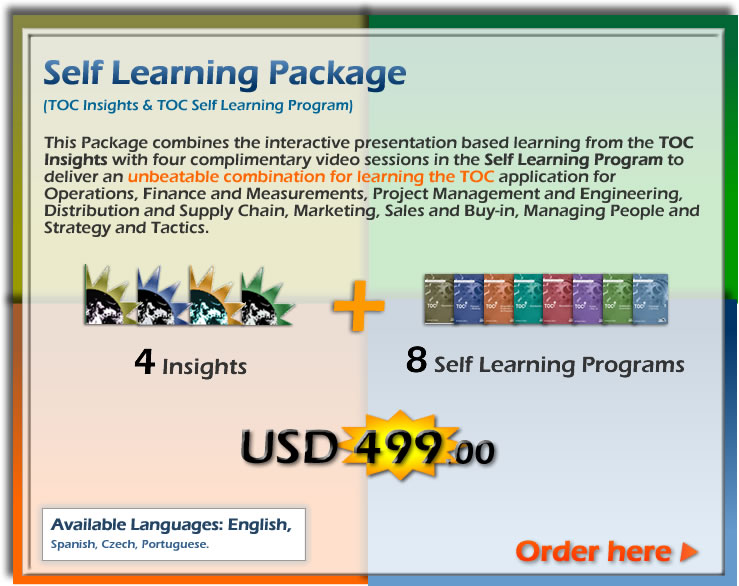
Friday, October 30, 2009
Eliyahu M Goldratts new book Isn't It Obvious on Theory of Constraints Replenishment
Eliyahu Goldratt has a new book coming out shortly. It's called Isn't it Obvious and it covers the Theory of Constraints replenishment solution for a retail store.
If you want to pre-order it, click here: Isn't It Obvious by Eliyahu M Goldratt
You can also read Chapter 4 of Eli's new book.
Tuesday, October 13, 2009
Theory of Constraints POOGI - Part 46
We are continuing our series based on The Goal by Eliyahu M Goldratt and the Theory of Constraints. {This series was co-written with Brad Stillahn.}
Do you really think you can do it all yourself?
Dr. Lisa: "Why do many small business owners try to do it all?"
Brad: "Well, we have a lot of reasons. And some good excuses. For some owners, it is affordability. Building a high quality management team is expensive. You have to have enough sales to be able to afford good people."
Dr. Lisa: "Just because you hire a person, doesn't mean he or she will be effective. Making a hiring mistake is very costly."
Brad: "That reminds me of a painful lesson I learned way back in the mid-1990's when my company was smaller. I was complaining to a couple of other business owners about the ineffectiveness of my General Manager. One of them asked me how much I paid the GM. I replied that I paid him $60,000 a year. He told me not to expect the performance of a $120,000 a year GM for half the price."
Dr. Lisa: "Of course, he was right. Too often we fill a key position with a body. Even a small company needs to run sales, operations, and accounting effectively. That requires good processes as well as good people."
Brad: "Let's talk about one of the most devastating reasons a small business owner tries to do it all: ego. I've been there, too. Too often being in charge is about always being right. But it's impossible for any one person to know it all."
Dr. Lisa: "Oh that reminds me of one of my favorite expressions: 'would your rather be right, or rich'?"
...to be continued.
Here's to maximizing YOUR profits!
Dr Lisa Lang
(c)Copyright 2009, Dr Lisa, Inc. All rights reserved.
Friday, September 4, 2009
Learn Goldratt Theory of Constraints with access to ALL the Videos for 1 Month
Some of the best self learning materials for Theory of Constraints are in video format. The problem has always been that they are expensive. The Goal video DVD (movie version of The Goal book by Eliyahu Goldratt) is $895 and the 8 CD set of the Self Learning Program is $999.
But for the month of September you can get both of those and a whole lot more of Goldratt's genius for only $499. Here what you will have access to:
Videos:
- The Goal movie on DVD (sells for $895)
- Necessary & Sufficient Series (10 CD set sells for $149)
- Goldratt Explains is a set of videos excerpts of past and/or unreleased conference presentations, where Dr. Eli Goldratt shares his analysis and developments on specific topics.
- TOCICO Conferences (sell for $249 for each conference and you get ALL of them)
- Goldratt Satellite Program (these are the 8 CDs that sell for $999)
- Realization Project Flow Conference of Critical Chain Project Management (CCPM)
- Goldratt Webcast Series on Critical Chain Project Management
Those videos cover all these topics (and more):
- Finance and Measurements
- Operations / Production
- Project Management
- Distribution
- Supply Chain
- Marketing
- Sales and Buy-In
- Managing People
- Strategy and Tactics
- Thinking Processes
- Change Management
- Buy-In
- Health Care
- Personal development
This one time opportunity provides full access to ALL videos on TOC.tv ONLY during the month of September, 2009.
HURRY! The sooner you get the access the more days you have it available. Access ends September 30th 2009.
To order and check started, click here:
Subscribe to:
Posts (Atom)